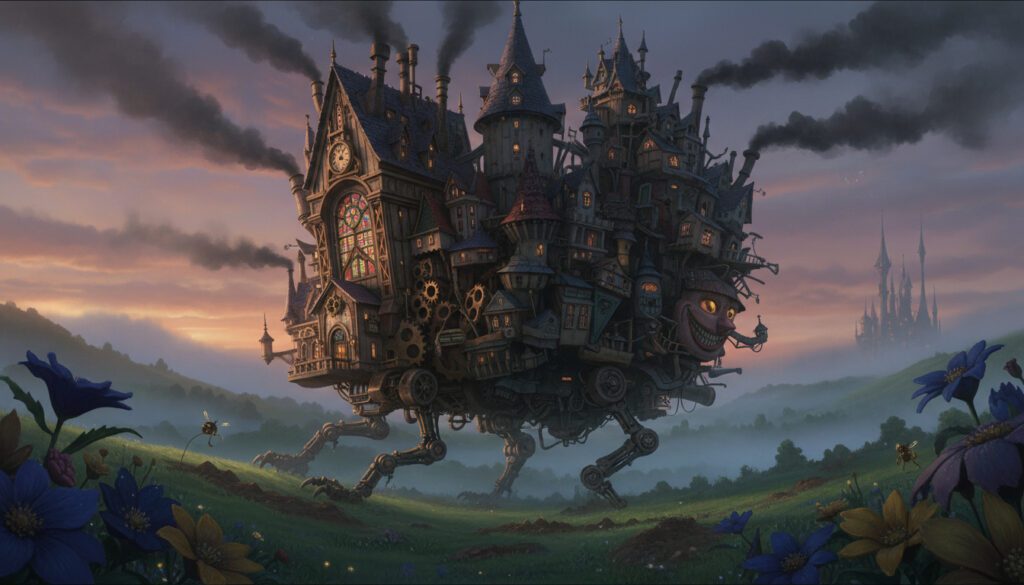
Howl’s Moving Castle Book – Summary, Characters and Movie Differences
In the kingdom of Ingary, where fairy tale conventions dictate that the eldest of three siblings never finds adventure, Diana Wynne Jones introduces Sophie Hatter, a young hat maker transformed into an elderly crone by a jealous witch. This premise opens Howl’s Moving Castle, a 1986 fantasy novel that subverts genre expectations through sharp wit, intricate magic systems, and a protagonist who discovers her power only after losing her youth.
The novel established Jones as a definitive voice in modern fantasy, weaving Welsh folklore with domestic comedy and high stakes. While Hayao Miyazaki’s 2004 animated adaptation expanded the story’s visual vocabulary for international audiences, the source material maintains distinct narrative complexities and resolutions that diverge significantly from the film.
What Is Howl’s Moving Castle Book About?
Litcharts details the plot: Sophie Hatter, eighteen years old and running her family’s hat shop in Market Chipping, attracts the jealousy of the Witch of the Waste, who curses her into the body of a ninety-year-old woman. Unable to explain her predicament, Sophie flees and enters the titular moving castle, a mechanical fortress that walks the wastes between towns and contains four magical doors opening onto different locations.
- The narrative subverts fairy tale tropes by making the eldest daughter the successful adventurer rather than the failure
- Sophie’s unrecognized magical ability to animate objects drives the plot’s resolution
- The castle’s four doors create a portal fantasy connecting Ingary to modern Wales
- Howl’s vanity and rumor-mongering mask his genuine magical power and moral complexity
- The Witch of the Waste functions as both inciting incident and primary antagonist
- Contracts and hearts serve as literal plot devices rather than mere metaphors
| Element | Details |
|---|---|
| Protagonist | Sophie Hatter (18, cursed to appear 90) |
| Setting | Kingdom of Ingary; Market Chipping; Wales |
| Magical Core | Howl’s heart powers Calcifer the fire demon |
| Key Antagonist | Witch of the Waste |
| Supporting Cast | Michael Fisher (apprentice), Mrs. Pentstemmon (mentor) |
| Plot Device | Seven-league boots, magical contracts, portal doors |
| Climax | Sophie restores Howl’s heart and destroys the Witch’s demon |
| Resolution | Curses lifted; Calcifer freed; Sophie and Howl unite |
| Awards | Boston Globe-Horn Book Award (1986) |
| Series Position | First in the World of Ingary trilogy |
| Target Audience | Ages 10+ (Middle Grade/Young Adult) |
Who Wrote Howl’s Moving Castle and When Was It Published?
The Author Behind the Fantasy
Diana Wynne Jones published Howl’s Moving Castle in 1986, cementing her reputation for fantasy narratives that interrogated genre conventions with intellectual rigor and humor. Her body of work consistently examined the practical implications of magic, establishing her as a distinct voice separate from both Tolkien-esque epic fantasy and simplistic children’s literature.
Publication Timeline and Series Context
Wikipedia confirms the novel debuted through Greenwillow Books in the United States and Methuen in the United Kingdom. The book initiated what became known as the “World of Ingary” series, though Jones structured the trilogy as loosely connected standalone novels rather than sequential chapters.
While Howl’s Moving Castle introduces the universe, readers need not consume the trilogy sequentially. Castle in the Air (1990) follows Abdullah in the land of Rashpuht, with Howl appearing only later, while House of Many Ways (2008) centers on Charmain Baker’s house-sitting adventures.
How Does the Book Differ from the Studio Ghibli Movie?
Plot and Ending Variations
In Jones’ novel, Howl literally gave his beating heart to Calcifer as a child, creating the contract that binds them. Miyazaki’s adaptation eliminates this biological connection, replacing it with a war-related curse and transforming the scarecrow into “Turnip Head” rather than the fused princes of the source material.
Character and Setting Changes
The film removes Howl’s Welsh identity entirely—his real name, Howell Jenkins, and his modern childhood accessed through the castle’s black door. Sophie shifts between young and old repeatedly in the movie, whereas the book confines her to elderly appearance until the final chapters. The Witch of the Waste survives in the film as a humbled companion, but Jones’ novel kills her during the climactic confrontation.
Tone and Thematic Shifts
Jones maintains a domestic, humorous atmosphere focused on household management and personal agency, while Miyazaki introduces explicit anti-war messaging and steampunk aesthetics absent from the source. The book’s concerns center on contractual obligation and self-perception rather than military conflict.
The novel reveals that Prince Justin and Wizard Suliman have been magically fused into the scarecrow “Percival,” a plot point entirely altered in the film adaptation.
Where Can I Read or Buy Howl’s Moving Castle Book?
Age Rating and Content Guidance
Goodreads community consensus recommends the novel for readers aged ten and older. The content includes magical peril, mild fantasy violence, and themes of transformation, but contains no explicit material, positioning it appropriately for middle grade and young adult collections.
Availability and Editions
The novel remains in print through multiple editions, including digital formats available on platforms like Kindle. HarperCollins maintains current editions for the North American market, while libraries worldwide stock the Greenwillow and Methuen imprints.
When comparing international print dimensions or cover art specifications, the Cm to Inches Converter – Free Tool, Chart & Formula provides useful measurement translation for collectors.
How Has Howl’s Moving Castle Evolved Since 1986?
- : Greenwillow Books and Methuen publish the hardcover debut
- : Winner of the Boston Globe-Horn Book Award for Fiction
- : Finalist for the Mythopoeic Fantasy Award
- : Castle in the Air extends the series with new protagonists
- : Studio Ghibli releases the animated adaptation directed by Hayao Miyazaki
- : House of Many Ways completes the World of Ingary trilogy
Source: BSFG Summary
What Is Fact and What Is Fiction in Common Understanding?
| Established Facts | Common Misconceptions |
|---|---|
| Howl’s birth name is Howell Jenkins from Wales | Howl is native to the fantasy world of Ingary |
| Sophie remains physically elderly until the final chapters | Sophie frequently shifts between ages throughout the narrative |
| Calcifer is a fallen star bound by Howl’s literal heart | Calcifer is a standard familiar or servant demon |
| The Witch of the Waste dies during the climax | The Witch survives and becomes a companion figure |
| No authorized free digital edition exists | The full text is legally available as a free PDF |
| The castle has four doors to specific locations | The castle moves randomly without fixed destinations |
What Themes and Cultural Elements Shape the Story?
Jones constructs her narrative around the systematic subversion of fairy tale logic, particularly the trope that the eldest of three siblings faces inevitable failure. Sophie’s journey from timid shopkeeper to confident sorceress mirrors the novel’s broader investigation of identity and the gap between self-perception and capability.
The author’s Welsh heritage informs Howl’s background, with the castle’s black door opening onto his childhood in modern Wales. The fandom wiki documents how this portal creates a unique juxtaposition between Ingary’s fairytale kingdom and 20th-century Britain, grounding the fantasy in specific cultural geography. Themes of contractual obligation—literalized through Howl’s heart given to Calcifer—intertwine with explorations of vanity, rumor, and the disparity between public reputation and private morality.
What Do Critics and Readers Say About the Book?
A giant jigsaw puzzle of fantasy where people and things are never what they seem.
The intricate mechanics of the curses and contracts reward close attention, creating a narrative that improves with each rereading.
— Critical consensus based on reader reviews
Why Should You Read Howl’s Moving Castle Today?
Nearly four decades after its publication, Jones’ novel retains its power through precise prose and genuine emotional stakes that transcend genre boundaries. The story offers a masterclass in plotting—every apparent digression ultimately serves the resolution, much like the structured patterns found in technical analysis such as the Cup and Handle Pattern – How to Identify and Trade, where individual elements converge into cohesive meaning. For readers seeking fantasy that respects intelligence while delivering warmth, the book remains essential.
Frequently Asked Questions
What age rating is appropriate for Howl’s Moving Castle?
The book suits readers aged 10 and older, containing mild fantasy peril without explicit content.
Is the Studio Ghibli movie faithful to the book?
The film captures the spirit but alters major plot points, removes the Wales setting, changes the ending, and adds anti-war themes absent from the source.
Can I legally read Howl’s Moving Castle online for free?
No authorized free PDF exists; access requires purchase or library borrowing through legitimate retailers and services.
How does Diana Wynne Jones’ style compare to other fantasy authors?
Jones employs precise, witty prose that treats magical elements with practical matter-of-factness, distinguishing her from both epic fantasy and simplistic children’s literature.
What makes Howl’s Moving Castle different from traditional fairy tales?
The novel subverts conventions by making the eldest sibling the hero, allowing the “evil” wizard to redeem himself, and treating magical contracts as literal legal bindings rather than metaphors.
More related posts
 Tig Notaro: Biography, Gender, Twins, and Career
 Super Bowl Start Time – Kickoff, Channel, Schedule & Location
 Real Madrid v Valencia: Late t Re ult, Live Stream & Ba ketball
 American Express Gold Card – Is It Worth the $325 Fee?
 Cast of Goodbye June – Full List and Production Details
 Kyle Tucker Blue Jays: $350M Offer and Dodgers Decision
 Barcelone – Real Sociedad – Match Preview, Lineups & Prediction
 Lower Right Abdomen Pain – Causes, Symptoms and When to Worry
