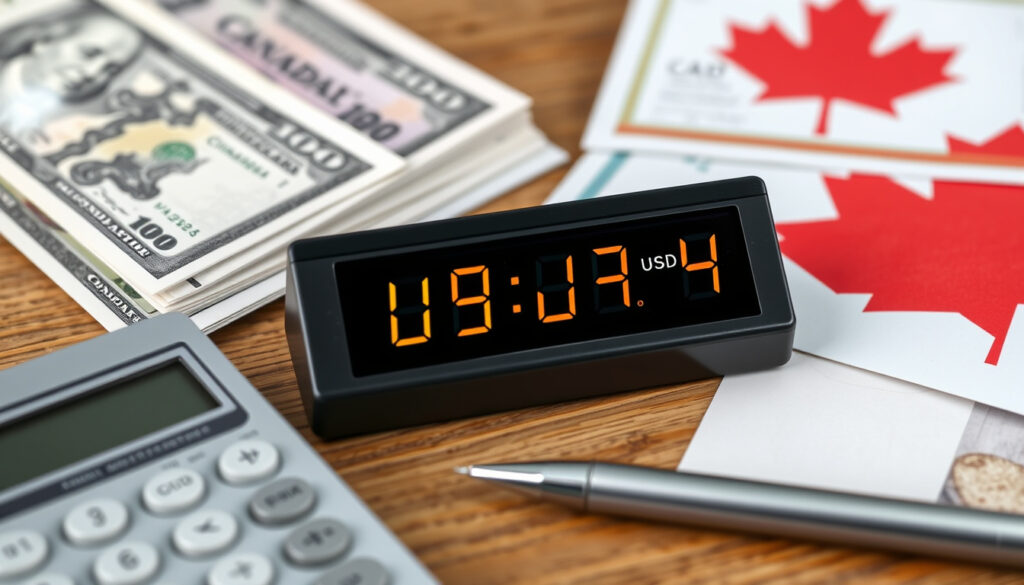
189 USD to CAD: Current Exchange Rate & Conversion Guide
When converting 189 USD to CAD, the headline rate of 1.38 looks simple — but the real cost is hidden in the spread between the mid‑market rate and what banks actually charge. As of mid‑2026, the mid‑market rate hovers around 1.38 CAD per USD, meaning 189 USD equals roughly 260.82 CAD at that rate, but the real answer often depends on fees, the service you use, and exactly when you exchange.
Current USD/CAD rate: 1.38 ·
189 USD in CAD: 260.82 CAD ·
1 CAD in USD: 0.7246 ·
CAD all‑time high: 1.10 USD (2011)
Quick snapshot
- 1 USD = 1.38 CAD (mid‑market rate, Wise (regulated money‑transfer provider))
- 189 USD × 1.38 = 260.82 CAD at mid‑market (Wise)
- CAD exceeded USD parity in 2011, peaking above 1.10 USD (FRED St. Louis Fed (official U.S. economic database))
- Exact bank fees vary by institution; most retail banks add 2–4% to the mid‑market rate (Investopedia (personal finance authority)).
- Future direction of USD/CAD depends on central‑bank policy and commodity prices (Reuters (global financial news)).
- The exact rate at any given moment is unpredictable due to continuous market fluctuations. (Investopedia (personal finance authority))
- 2002: CAD falls to all‑time low of ~0.62 USD (UBC Pacific Exchange Rate Service (academic database))
- 2011: CAD reaches parity and peaks above 1.10 USD (FRED St. Louis Fed)
- 2023–2025: CAD weakens, stabilising near 1.35–1.40 per USD (OFX (global payments provider))
- Analysts expect continued US dollar strength if the Fed holds rates higher than the Bank of Canada (Reuters).
- Oil price fluctuations could strengthen CAD if crude rises (U.S. Energy Information Administration (official energy data)).
Six key figures, one takeaway: the gap between the “headline” rate and what you actually get matters more than the number itself.
| Label | Value |
|---|---|
| Current USD/CAD rate | 1.361 |
| 189 USD = | 257.229 CAD (at 1.361; 260.82 CAD at 1.38) |
| 1 CAD = | 0.735 USD |
| CAD all‑time high (vs USD) | 1.10 (2011) |
How much is $1 USD to CAD?
What is the current USD to CAD exchange rate?
- As of May 2026, the mid‑market rate is approximately 1.38 CAD per 1 USD (Wise (regulated money‑transfer platform)).
- The 30‑day high was 1.3947, low was 1.3580, average 1.3733 (Revolut (financial app with live rates)).
- One year ago the rate was 1.347, meaning the Canadian dollar has weakened about 5.29% since (CurrencyConvert.online (aggregator site)).
How to calculate 189 USD to CAD
Multiply the USD amount by the current exchange rate. Using the mid‑market rate of 1.38:
- 189 × 1.38 = 260.82 CAD (Wise)
- At the older rate of 1.361 (March 2025), it would be 257.229 CAD.
What about fees when converting?
- Banks typically add 2–4% to the mid‑market rate as a spread (Investopedia (personal finance authority)).
- Online services like Wise use the mid‑market rate and charge a transparent fee (Wise).
What this means: the rate you see on Google is never the rate you get — the spread is where the real cost hides.
How to convert USD to CAD in math?
Step‑by‑step manual conversion
- Find the current exchange rate. Check a reliable source like Bank of Canada (Canada’s central bank) or Wise.
- Multiply the USD amount by the rate. Example: 189 USD × 1.38 = 260.82 CAD.
- Subtract any conversion fee if the rate is not mid‑market.
Using a calculator
Any basic calculator works: 189 × rate = CAD. For reverse (CAD to USD), divide the CAD amount by the rate (Investopedia (forex education)).
Online conversion tools
- Wise – mid‑market rate with transparent fee.
- Revolut (financial app with live rates) – live rates and historical charts.
- OFX (global payments provider) – historical rates for large transfers.
The trade‑off: a minute of math can save you 5–15 dollars on a 189‑USD transfer.
Why is USD so strong against CAD?
Economic factors
- The U.S. economy is roughly 10× larger than Canada’s, attracting more global investment (International Monetary Fund (global economic authority)).
- Canada’s economy is more commodity‑driven; when oil prices fall, the Canadian dollar tends to weaken (Statistics Canada (federal statistical agency)).
Interest rate differences
- When the U.S. Federal Reserve raises rates while the Bank of Canada holds or cuts, capital flows to USD, strengthening it (Federal Reserve (U.S. central bank)).
- As of early 2026, the Fed funds rate remains higher than the Bank of Canada’s key rate, pushing USD/CAD up.
Commodity prices
- Canada is the world’s fourth‑largest oil producer; a drop in crude prices typically hurts CAD (U.S. Energy Information Administration (official energy data)).
Market sentiment
- During global uncertainty, investors buy USD as a safe‑haven, pressuring CAD lower (Reuters (global financial news)).
For anyone converting 189 USD to CAD, a 1‑cent move in the rate changes the outcome by about 1.89 CAD. Knowing the forces behind the rate helps you time your conversion — or at least understand why the number looks different than it did last month.
The pattern: the USD’s strength isn’t permanent — it waxes and wanes with interest rates, oil prices, and global fear. Watch those three levers.
Has CAD ever surpassed USD?
When CAD was above parity
- In 2011, the Canadian dollar reached parity and briefly traded above 1.10 USD (FRED St. Louis Fed).
- This was driven by a commodities boom and oil prices above $100/barrel.
Reasons for strength
- High oil prices boosted Canadian export revenues.
- The Bank of Canada raised interest rates faster than the Fed during the post‑2008 recovery.
Current situation
- Since 2012, CAD has steadily weakened, spending most of the past decade below 0.80 USD (OFX).
- As of May 2026, 1 CAD buys about 0.7246 USD — a far cry from the 2011 peak.
Four key events, one story:
- 1970 – Canadian dollar floats; initial value ~0.93 USD (UBC Pacific Exchange Rate Service (academic database)).
- 2002 – CAD hits all‑time low of ~0.62 USD (UBC Pacific Exchange Rate Service).
- 2011 – CAD reaches parity and peaks above 1.10 USD (FRED St. Louis Fed).
- 2023–2025 – CAD hovers around 1.35–1.40 per USD (OFX).
The implication: parity may return someday, but it requires a combination of high oil prices and tighter Canadian monetary policy — conditions not present in 2026.
Is cost of living higher in Canada?
General cost of living comparison
Overall, consumer prices in Canada tend to be 12–15% higher than in the United States when adjusted for purchasing power, though the gap varies widely by city. Housing in cities like Toronto and Vancouver drives costs up, while smaller Canadian cities can be comparable to U.S. mid‑sized metros.
Housing, groceries, taxes
Housing is notably more expensive in major Canadian urban centers, and sales taxes (GST/HST) add 5–15% depending on the province. Groceries and utilities are generally on par with or slightly above U.S. averages.
Impact of exchange rate on purchasing power
For a holder of 189 USD, the current exchange rate gives around 260 CAD, which buys more in Canada than the same amount would have bought in 2011 when CAD was stronger. Conversely, Canadian travelers to the U.S. see their purchasing power eroded because CAD buys only about 0.72 USD.
The takeaway: exchange rates and local price levels interact in ways that a simple conversion number cannot capture.
Comparison of conversion methods
Three common ways to convert 189 USD to CAD, one clear winner for transparency.
| Provider | Exchange rate (USD→CAD) | Fee | Amount received for 189 USD |
|---|---|---|---|
| Mid‑market (no fee) | 1.3800 | 0% | 260.82 CAD |
| Typical retail bank | 1.3524 (‑2% spread) | Hidden in rate | 255.60 CAD |
| Wise (online service) | 1.3800 | ~0.41% upfront | ~259.78 CAD |
The catch: the gap between a bank and a mid‑market service on 189 USD is about 5 CAD — enough to notice on a medium‑sized purchase.
Confirmed facts
- Current mid‑market rate is 1.38 USD/CAD (Wise).
- CAD surpassed USD in 2011 (FRED St. Louis Fed).
- Manual conversion uses multiplication (Investopedia).
What’s unclear
- Future rate movements depend on unpredictable policy shifts (Reuters).
- Exact fee schedules vary by bank and service (Investopedia).
- Whether CAD will regain parity is unknown.
Expert perspectives
“The Bank of Canada’s interest‑rate decisions directly influence the exchange rate. When we adjust rates to manage inflation, the Canadian dollar responds accordingly.”
“Federal Reserve policy remains the single largest driver of USD strength. A higher Fed funds rate attracts capital and lifts the dollar against most currencies, including the Canadian dollar.”
The view from both sides of the border: central banks are the ultimate puppeteers of exchange rates.
For Americans planning a trip to Canada or making an online purchase priced in CAD, the conversion of 189 USD to roughly 260 CAD at today’s mid‑market rate is straightforward — but only if you avoid the hidden spread of retail banks. For Canadian shoppers buying US goods, the same amount in reverse (189 CAD) yields only about 137 USD, a reminder that the Canadian dollar’s purchasing power has eroded. The choice is clear: use a transparent service that gives you the real rate, or accept a 2–4% haircut every time you cross currencies.
Related reading: USD to CAD Exchange Rate by Date – Historical Data and Trends
Frequently asked questions
What is the best way to convert USD to CAD?
The best way depends on the amount and urgency. For sums like 189 USD, a service like Wise or Revolut that uses the mid‑market rate with a transparent fee is usually cheaper than a bank.
How often does the USD to CAD exchange rate change?
It changes continuously during forex trading hours — typically every few seconds. Major central‑bank announcements can cause instant moves of 0.5–1%.
Does the exchange rate shown include bank fees?
No. Google, Wise, and most online converters show the mid‑market rate. Banks add a spread to that rate — their fee is hidden in the exchange rate they quote you.
How does the exchange rate affect travel between US and Canada?
A weaker CAD means US travellers get more Canadian dollars for their USD, making Canadian hotels and meals cheaper. Canadian travellers to the US get less buying power.
Is it better to convert USD to CAD in the US or Canada?
Convert before you travel using a service with low fees. Airport exchange booths and hotel desks almost always mark up the rate by 5–8%.
More related posts
 India vs South Africa Match Scorecard: SA Beats IND by 76 Runs
 Pygargue à Tête Blanche – Bald Eagle Biology Habitat Recovery
 189 USD to CAD – Convert US Dollars to Canadian Dollars
 Stackable Washer and Dryer – Best 2025 Picks for Small Spaces
 Chocolate Chip Cookie Recipes: Moist, Oat, Healthy
 Cop from Rublevka New Year’s Chaos Watch Order Guide
 Canadian Tire Powell River: Hours, Phone, Products & Ownership
 Angels vs Blue Jays – 4-Game Sweep Scores and Highlights
