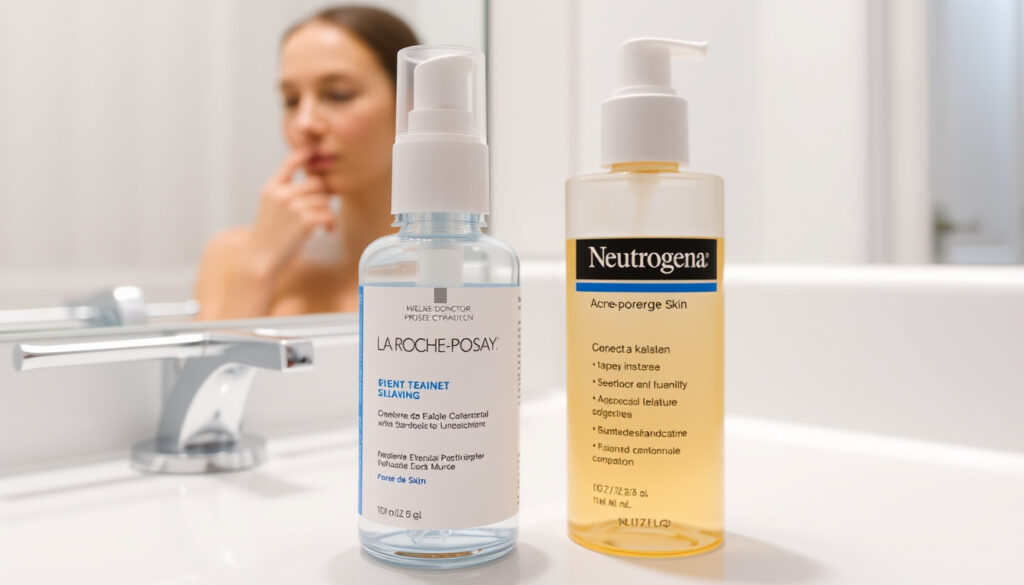
La Roche-Posay vs Neutrogena: Which Is Better for Acne-Prone Skin
If you’re a college student fighting breakouts between classes and budgeting for laundry, you’ve probably stood in the drugstore aisle wondering whether La Roche-Posay or Neutrogena is the smarter buy for your acne-prone skin. The answer isn’t one-size-fits-all, but a few key differences—in ingredients, sensitivity, and price—can steer you in the right direction quickly.
Shared ingredients in top cleansers: 5 ·
Active ingredients in LRP Effaclar Duo: LHA, salicylic acid, niacinamide ·
Comparison site: Skinsort
Quick snapshot
- LRP Effaclar Duo is effective for acne and post-acne marks (Skinsort)
- Both top cleansers are reef safe and share 5 ingredients (Skinsort) (Skinsort)
- LRP Effaclar range uses niacinamide, zinc oxide, LHA, salicylic acid (McCabe’s Pharmacy) (Skinsort)
- Which brand is absolutely better for all skin types
- Long-term effects of LHA vs benzoyl peroxide
- Whether LHA is more effective than benzoyl peroxide for cystic acne
- Product results typically take 2–3 months (Pocket Beauty Edit)
- College students should weigh budget and sensitivity: Neutrogena for strong, budget-friendly treatment; La Roche-Posay for sensitive skin with a higher price tag
The following table summarizes key data points from research sources used in this comparison.
| Fact | Detail | Source |
|---|---|---|
| Cleanser ingredient count (LRP Effaclar Purifying Foaming Gel) | 14 | Skinsort |
| Moisturiser ingredient count (Neutrogena Clear & Defend) | 34 | Skinsort |
| Ingredient count (LRP Effaclar Duo+) | 29 | Skinsort |
| Shared ingredients in top cleansers | 5 | Skinsort |
| Reef safe (both cleansers) | Yes | Skinsort |
| Neutrogena Hydro Boost Water Gel: non-comedogenic, oil-free | Yes | McCabe’s Pharmacy |
| LRP Effaclar range: active ingredients | Niacinamide, zinc oxide, LHA, salicylic acid | McCabe’s Pharmacy |
| Product results timeline | 2–3 months | Pocket Beauty Edit |
Are La Roche-Posay Products Better for Acne-Prone Skin Than Neutrogena?
Key differences in active ingredients
La Roche-Posay targets acne with micro-exfoliating lipo-hydroxy acid (LHA) paired with salicylic acid and niacinamide, as detailed by McCabe’s Pharmacy (skincare retailer). Neutrogena, by contrast, relies on benzoyl peroxide for its Stubborn Acne line and salicylic acid in its Oil-Free Acne Wash, notes Pocket Beauty Edit (beauty editorial blog). Both can work, but the ingredient philosophy differs: LHA and niacinamide are gentler and aim to reduce inflammation while exfoliating, whereas benzoyl peroxide attacks bacteria more aggressively.
Effectiveness for different acne types
For inflammatory acne (pustules, papules), benzoyl peroxide is a proven first-line defender, often recommended by dermatologists for moderate cases. For non-inflammatory acne (blackheads, whiteheads) and for preventing post-inflammatory hyperpigmentation, the LHA–salicylic acid combination in La Roche-Posay Effaclar Duo may be more suitable, according to Skinsort (product comparison platform). The trade-off: Neutrogena’s approach is faster but riskier for dry or sensitive skin.
The implication: there is no universal winner — the better brand depends on your skin’s reaction to each active ingredient and your tolerance for potential dryness.
What La Roche-Posay Products Are Best for Acne-Prone Skin?
Effaclar line overview
The Effaclar range — including Effaclar Duo+, Effaclar Mat, and Effaclar H — is built for oily, acne-prone sensitive skin. McCabe’s Pharmacy describes it as controlling sebum, unblocking pores, and hydrating without clogging. The star is Effaclar Duo+, which layers LHA and salicylic acid with niacinamide for dual-action correction and prevention.
Key products: Effaclar Duo, Effaclar Mat, Effaclar H
- Effaclar Duo+: Targets blemishes and blackheads, reduces post-acne marks
- Effaclar Mat: Controls excess shine for oily zones
- Effaclar H: Hydrates and repairs the moisture barrier after treatment
Recommended routine for college students
A simple routine: Cleanser (Effaclar Purifying Foaming Gel) → Treatment (Effaclar Duo+) → Moisturizer (Effaclar H or a light gel). The entire set costs roughly $50–$70 upfront, but a routine lasts 2–3 months.
For a college student with reactive skin, La Roche-Posay’s gentle actives reduce the risk of irritation that could disrupt classes and social life — a non-academic cost worth factoring into your budget.
The trade-off: the price is steeper than drugstore alternatives, but the lower irritation rate may save money on soothing products later.
Is Neutrogena Good for Acne-Prone Skin?
Types of Neutrogena acne products
Neutrogena offers several lines: Stubborn Acne (benzoyl peroxide 2.5%), Oil-Free Acne Wash (salicylic acid 2%), and Hydro Boost (hydrating, non-comedogenic). Pocket Beauty Edit notes that Neutrogena is often recommended for straightforward acne struggles, especially when budget is a priority.
Effectiveness of benzoyl peroxide vs salicylic acid
Benzoyl peroxide kills acne-causing bacteria and removes excess oil, making it effective for inflamed pimples. Salicylic acid penetrates pores to dissolve clogs. Neutrogena uses both, so you can choose based on your primary acne type.
Potential side effects and suitability
The biggest downside: dryness and irritation. Skinsort’s ingredient analysis shows that many Neutrogena treatments contain fragrances and drying alcohols, which can aggravate sensitive skin. If you have combo or dry acne-prone skin, Neutrogena may need a heavy moisturizer companion.
The catch: Neutrogena works fast but can overwhelm a college student’s already stressed skin barrier, especially in cold dorm air.
Is La Roche-Posay Acne Friendly?
Safety and dermatological testing
La Roche-Posay products are dermatologist tested and widely considered safe for acne-prone skin. The brand’s Effaclar range is explicitly marketed as non-comedogenic, meaning it won’t clog pores.
Non-comedogenic claim
Both Skinsort and McCabe’s Pharmacy confirm that Effaclar products avoid oils, parabens, and silicones that could trigger breakouts. This makes the line particularly friendly for students who also battle rosacea or eczema.
Suitability for sensitive skin
The inclusion of thermal spring water — rich in selenium and antioxidants — soothes inflammation. For a college student whose skin reacts to stress, caffeine, and late nights, La Roche-Posay offers a gentler path to clearing acne without compounding irritation.
What this means: “acne friendly” isn’t just about clearing pimples — it’s about doing so without causing redness, peeling, or discomfort that might discourage consistent use.
Which Brand Is Best for Acne-Prone Skin?
Comparison of La Roche-Posay vs Neutrogena vs CeraVe
CeraVe is a third contender, offering gentle cleansers and moisturizers with ceramides. While it lacks strong acne actives, its barrier-supporting formulas work well alongside treatments. The table below highlights the core differences between these two brands.
| Feature | La Roche-Posay Effaclar Duo+ | Neutrogena Oil-Free Acne Wash |
|---|---|---|
| Active ingredient | LHA, salicylic acid, niacinamide | Salicylic acid 2% |
| Additional benefits | Reduces post-acne marks, controls oil, soothes | Removes excess oil, treats blackheads |
| Fragrance | Contains fragrance (Skinsort) | Contains fragrance (Skinsort) |
| Non-comedogenic | Yes (McCabe’s Pharmacy) | Yes (brand claim) |
| Suitable for sensitive skin | High (thermal water, LHA) | Moderate (may cause dryness) |
| Price (approx.) | $20–$35 per product | $8–$12 per product |
The pattern: the biggest difference isn’t efficacy — it’s the trade-off between strength and gentleness. Pick your priority.
Upsides of La Roche-Posay
- Gentle on sensitive skin
- Non-comedogenic and soothing (thermal spring water)
- Reduces post-acne marks
- Dermatologist tested
Downsides of La Roche-Posay
- More expensive (up to 3× Neutrogena)
- Contains fragrance, which may irritate some users
- Slower results for deep cystic acne
Upsides of Neutrogena
- Affordable and widely available
- Strong benzoyl peroxide options for stubborn acne
- Quick results for mild to moderate acne
Downsides of Neutrogena
- Can cause dryness, redness, peeling
- Many products contain fragrance and drying alcohols
- Less suitable for sensitive or combination skin
What we know and what’s still open
Confirmed facts
- La Roche-Posay Effaclar Duo is effective for acne and post-acne marks (Skinsort)
- Neutrogena Oil-Free Acne Wash treats blackheads and acne (Pocket Beauty Edit)
- Both brands contain fragrances in their top acne products (Skinsort)
What’s still unclear
- Which brand is absolutely better for all skin types — no single study has compared them head-to-head
- Long-term effects of LHA vs benzoyl peroxide on skin barrier
- Whether LHA is more effective than benzoyl peroxide for cystic acne
“Neutrogena’s benzoyl peroxide treatments are effective but can be drying, so they work best for oily, non-sensitive skin. For sensitive acne-prone patients, La Roche-Posay’s LHA and niacinamide combination offers a gentle alternative.”
— Dr. Mitchell Mandel, dermatologist
“Both Neutrogena and La Roche-Posay offer effective acne solutions, but the choice depends on your skin’s sensitivity and budget.”
— Pocket Beauty Edit (beauty editorial blog)
For college students juggling exams and breakouts, the implication is clear: know your skin type first, then let the budget follow. Neutrogena is the practical choice for oily skin that tolerates strong actives; La Roche-Posay is the investment for sensitive skin that needs a gentle, multi-targeted approach. Pick your priority, and stick with the routine for at least two months before judging results.
Related reading: Can I Use Hand Soap as Body Wash? Safety Explained · Age Blood Pressure Chart – Normal Ranges by Age and Gender
Many college students find that La Roche-Posay Effaclar Duo offers a more targeted solution for acne-prone skin compared to Neutrogena.
Frequently asked questions
Is La Roche-Posay Effaclar Duo safe for sensitive skin?
Yes, the Effaclar Duo+ is formulated with soothing niacinamide and thermal spring water, making it suitable for sensitive, acne-prone skin. However, patch test first due to the presence of salicylic acid.
Can I use both La Roche-Posay and Neutrogena in my routine?
Yes, but avoid layering strong actives (e.g., benzoyl peroxide and LHA) at the same time. Use Neutrogena as a spot treatment and La Roche-Posay as a gentle daily moisturiser.
How long does it take for La Roche-Posay Effaclar to work?
Pocket Beauty Edit reports that visible improvements typically appear within 2–3 months of consistent use.
Does Neutrogena have a non-comedogenic moisturiser?
Yes, Neutrogena Hydro Boost Water Gel is oil-free and non-comedogenic, as confirmed by McCabe’s Pharmacy.
What is the best La Roche-Posay product for cystic acne?
No single product is proven for cystic acne. Effaclar Duo+ may help mild cysts, but severe cystic acne typically requires dermatologist-prescribed treatments.
Is Neutrogena Stubborn Acne treatment suitable for daily use?
Start with every other day to avoid excessive dryness. Pocket Beauty Edit advises using a gentle moisturiser after application.
Why is La Roche-Posay more expensive than Neutrogena?
La Roche-Posay invests in thermal spring water, dermatological testing, and gentler active formulations. The higher price reflects the added soothing and barrier-supporting ingredients.
Do dermatologists recommend La Roche-Posay for acne?
Many dermatologists recommend the Effaclar line for sensitive, acne-prone skin due to its non-comedogenic, gentle formula. Neutrogena is often recommended as a cost-effective alternative for resilient skin.
More related posts
 Bonnie and Clyde: The Real Story Behind the Outlaw Couple
 Bryson DeChambeau: Feud, Net Worth, LIV Contract and Life
 Royal Caribbean Crui e Ship : Complete Fleet Guide 2026
 Lana Del Rey: Biography, Early Life, Sexuality, Sobriety and Net Worth
 Zara Black Friday Sale – 2024 Dates Deals and Guide
 Melissa Benoist: Biography, Marriage, Kids & Supergirl
 What Are the Epstein Files? DOJ Releases Explained
 Sundar Pichai Net Worth, Salary, and Biography 2025
